
What is an astrology system, and why do they disagree?
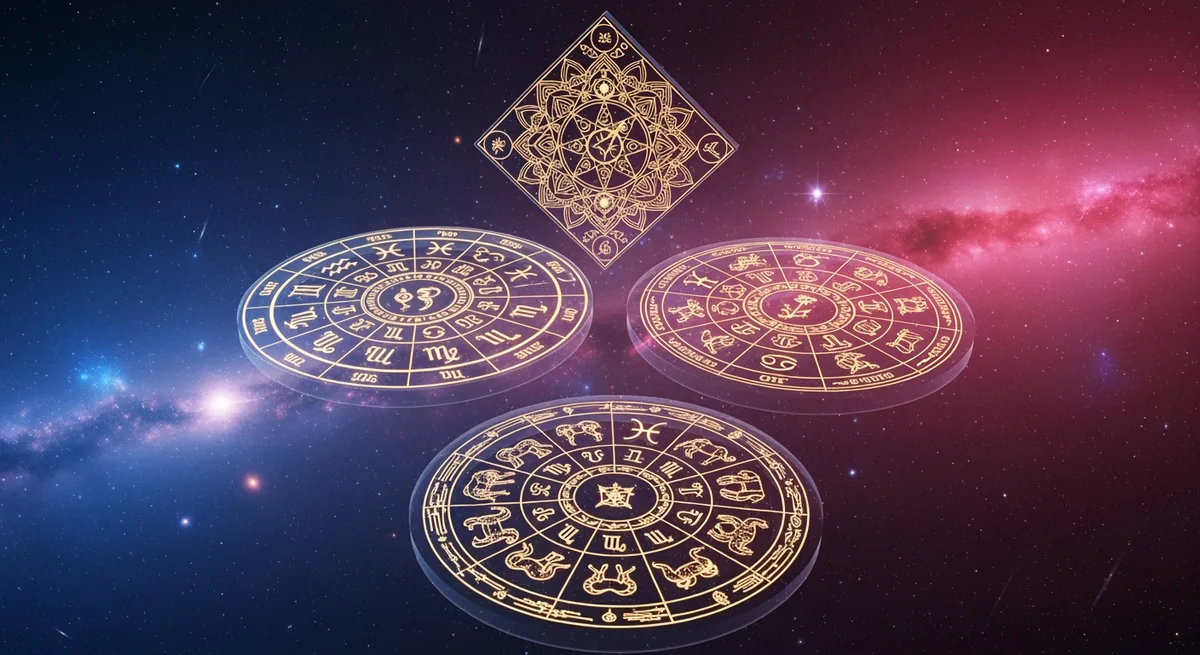
If you've ever compared two readings of your birth chart and felt like they were describing two different people, you weren't imagining it. Astrology isn't one single thing — it has several different systems, and each one uses a different zodiac, a different house framework, and sometimes even a different set of planets, or no planets at all. None of them are wrong; they're just different lenses on the same moment. A useful way to picture it: a city can be mapped as a street map, a transit map, and a topographic map. All three are honest, all three are useful, and you reach for a different one depending on what you're trying to do. Astrology's systems are like that — built by different cultures, for different questions, over thousands of years.
What an 'astrology system' even means
At its simplest, a system is a complete, self-consistent method for turning a moment in time (and usually a place) into meaning. Most systems share a few moving parts: a zodiac or framework that divides the sky or the calendar, a set of significators (planets, numbers, cards, or elements) that carry meaning, a way of placing those significators into houses or positions, and a timing engine that says when an influence is active. What makes the systems disagree is that they make different choices at each of those steps — a different starting point for the zodiac, a different way to cut the houses, a different cast of significators. Once you see the parts, the 'disagreements' stop looking like contradictions and start looking like different settings on the same instrument.
Vedic (Parashari)
The Vedic system is the oldest and most widely practiced in India. It uses the sidereal zodiac (anchored to the actual positions of the stars, with the Lahiri correction) and the Whole Sign house framework. Its great strength is timing — the Vimshottari Dasha cycle gives a year-by-year breakdown of which planet is influencing your life.
KP (Krishnamurti Paddhati)
KP is a 20th-century refinement of the Vedic system. It keeps the sidereal zodiac but adds sub-lord theory — each degree of each sign is sub-divided in Vimshottari proportions, so a planet's effect depends not just on its sign but on whose sub it sits in. People love it for precise event timing (marriages, job changes) more than for personality reading.
Western (tropical)
The Western system uses the seasons rather than the stars — Aries always starts at the spring equinox. The houses are Placidus, which divides time rather than space. The same birth moment can put you in Aries by the Vedic sidereal system but Taurus by the Western tropical one, because the two zodiacs have drifted about 24° apart. Western astrology tends to lean into psychology and character — the why behind how you tick — which is part of why it feels so different in tone from the event-focused Indian systems, even when both are looking at the same planets.
Numerology (Pythagorean)
Numerology steps away from the sky entirely and works from numbers. The Pythagorean tradition reduces your date of birth and the letters of your name to single digits, each carrying a meaning, and from them derives figures like your Life Path and expression numbers. There's no chart of planets here at all — the raw material is arithmetic and the symbolism humans have long attached to numbers. It's quick to compute and easy to relate to, which is why it often serves as a friendly entry point alongside the heavier chart-based systems.
Chinese Bazi and Korean Saju
Then there are systems with completely different roots. Chinese Bazi (the Four Pillars of Destiny) builds four pillars from the year, month, day and hour of birth, each made of a Heavenly Stem and an Earthly Branch, and reads everything in terms of the five elements and a central 'Day Master' that represents you. Korean Saju is its close cousin, sharing the same engine in its own tradition. These systems read time through the Chinese calendar rather than computing positions from the sky, and their genius is elemental balance and decade-long luck cycles rather than planet-in-sign personality sketches.
Tarot
Tarot is different again: it isn't tied to your birth data at all. A reading draws cards from a deck of archetypes — the Fool's journey of the Major Arcana, and the suits of the Minor Arcana — and arranges them in a spread to reflect on a question in the present moment. Where the chart-based systems describe a fixed birth map, Tarot is a snapshot of now: a mirror for thinking through a situation, prompting reflection rather than calculating a horoscope.
Lo Shu (the magic square)
Lo Shu numerology comes from Chinese tradition and arranges the digits of your birth date onto a 3×3 grid — the ancient 'magic square' in which every row, column and diagonal sums to fifteen. Which numbers appear, repeat, or are missing forms a picture of your strengths and tendencies, and the grid also yields figures sometimes called the driver and conductor. Like Pythagorean numerology it works from your birth numbers rather than the planets, but its layout and symbolism are entirely its own.
A worked example: one birth, several lenses
Take a single person born on a spring morning and run them through a few systems. The Western tropical chart, anchored to the season, might call them a Sun-in-Aries — fiery, direct, a natural starter. The Vedic sidereal chart, anchored to the stars and drifted about 24° from the tropical zodiac, may place that same Sun back in Pisces, and then add a Vimshottari Dasha timeline saying which planet's chapter they're living through right now. KP would keep that sidereal placement but zoom in on the sub-lord of each relevant point to pin down when an event is likely. Bazi would ignore the planets entirely and describe them through a Day Master element and a five-element balance. Numerology and Lo Shu would set the planets aside again and read the digits of that birth date. None of these is overruling the others — each answers a slightly different question. The Aries/Pisces 'contradiction' is just two zodiacs measured from two different starting lines, and noticing that is often the moment astrology starts to make sense rather than seeming arbitrary.
How they complement each other
Because each system is strongest at a different thing, they tend to work better together than in competition. The Indian systems (Vedic and KP) shine at timing — when a phase begins, when an event is likely. Western astrology is rich for character and psychology. Bazi and Saju excel at elemental balance and the rhythm of luck across decades. Numerology and Lo Shu give a fast, intuitive read from your birth numbers. Tarot is unmatched for reflecting on a live question right now. Run the same theme through two or three of them and you'll usually find they agree on the big strokes and differ on the fine detail — and that overlap, where independent methods point the same way, is often more reassuring than any single reading.
Which one should you use?
Whatever resonates with you. LuckMap lets you switch systems anytime, so you can run the same question through Vedic and KP and compare side by side. Most people find the answers agree on the big themes and differ on the finer timing details — and that comparison is often the most useful reading of all. If you're new, a gentle path is to start with one chart-based system for your core map (Vedic or Western), add a numerology or Lo Shu read for a quick second angle, and keep Tarot for moments when you want to think a specific question through. There's no prize for picking the 'right' one — the best tool is the one that helps you reflect honestly.
Frequently asked questions
If the systems disagree, doesn't that mean astrology is just made up? Disagreement on the surface usually comes from different measuring conventions, not from chaos. The Vedic and Western zodiacs start from different points, so a Sun sign can differ by a whole sign — but that's a known, fixed offset of about 24°, not randomness. The systems are internally consistent; they simply answer different questions with different settings. Whether you take any of it as literal is a personal matter, but the 'they all contradict each other' objection mostly dissolves once you see how each one is built.
Which system is the most accurate? There isn't a single most-accurate system, because they're not all trying to measure the same thing. Vedic and KP are prized for timing, Western for psychology, Bazi and Saju for elemental balance and luck cycles, numerology and Lo Shu for a quick read from your numbers, and Tarot for reflecting on the present. 'Accuracy' depends on the question you're asking, so the better instinct is to match the system to the question rather than to crown a winner.
Can I mix systems, or should I stick to one? You can absolutely mix them, and many people find that the most useful approach. Because each is strong in a different area, reading the same theme through two or three lenses tends to surface where they agree — and that agreement across independent methods is often the most grounded takeaway. Starting with one core system and adding others as you go keeps it from feeling overwhelming.
Do I need an exact birth time for all of them? It varies by system. Chart-based systems like Vedic, KP and Western are most precise with an accurate birth time, since the houses and the ascendant shift through the day. Bazi wants the birth hour for its fourth pillar. Numerology, Lo Shu and Tarot, by contrast, don't depend on a birth time at all — they work from your birth date or from the present moment — which makes them handy when a time isn't known.