Tarot for beginners: the 78-card deck and how a reading works
Tarot is one of the most misunderstood tools in the divination world. It isn't a crystal ball, and a good reading doesn't tell you what will happen on a specific date. What tarot actually offers is a structured way to reflect — a deck of 78 image-rich cards that, when drawn and arranged, prompt you to look at a situation from angles you might have been avoiding. Whether you believe the cards are guided by something or simply act as a mirror for your own intuition, the practical value is the same: clarity.
It also helps to know what tarot is not, because the myths put a lot of people off before they start. It isn't fortune-telling that locks in your fate, it isn't tied to any one religion, and you don't need a 'gift' to read it. At its core, tarot is a deck of pictures rich enough to make you think — and the thinking is the point. Once you drop the idea that the cards are issuing verdicts, the whole practice becomes a lot more useful and a lot less intimidating.
The structure of the deck
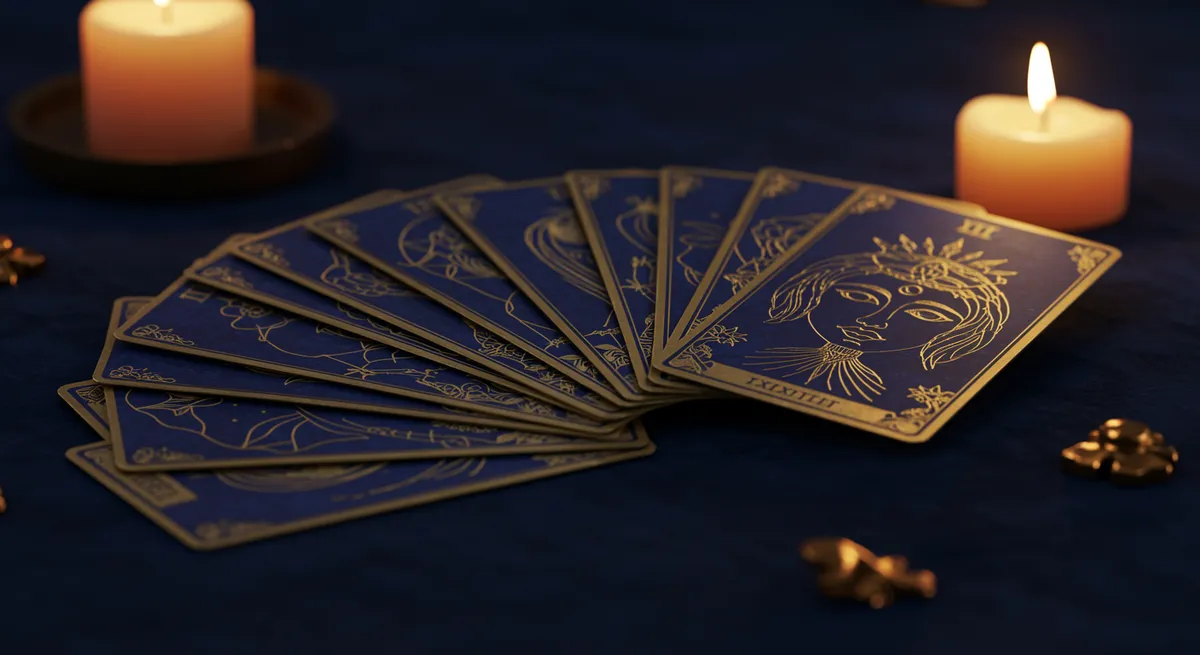
A standard tarot deck has 78 cards in two groups. The 22 Major Arcana are the big, archetypal cards — The Fool, The Lovers, Death, The Tower, The Star, The World, and so on. They represent major life themes and turning points. The 56 Minor Arcana handle everyday matters and are split into four suits: Wands (fire — drive, passion, work), Cups (water — emotions, relationships), Swords (air — thoughts, conflict, truth), and Pentacles (earth — money, body, the material world). Each suit runs Ace through Ten plus four court cards (Page, Knight, Queen, King).
A quick way to make the deck feel less overwhelming is to read it in layers. When a Major Arcana card shows up, the reading is touching on a big, defining theme — these are the headline cards. When the Minor Arcana speak, you're in the realm of the day-to-day. Within the Minors, the suit tells you the area of life (work, emotions, thoughts, or material matters) and the number or court rank tells you the stage or the kind of person involved. You don't have to memorise all 78 meanings to start; knowing what each suit governs already lets you take a rough read on most spreads.
The court cards
The court cards — Page, Knight, Queen, and King in each suit — trip up a lot of beginners, so they're worth a moment on their own. They can represent actual people in your life, aspects of your own personality, or the energy a situation is asking for. A simple way to hold them: the Page is the learner or the spark of a new idea, the Knight is the doer who charges ahead (sometimes too fast), the Queen embodies the suit's energy with depth and care, and the King expresses it with mastery and authority. Read through the lens of the suit, a Knight of Cups is very different from a Knight of Swords — one is romantic and idealistic, the other sharp and confrontational. When a court card appears, it's usually worth asking whether it's pointing at a person, at you, or at a quality you need more of.
Upright and reversed
Many readers also read cards as 'reversed' — upside down. A reversed card doesn't simply mean the opposite of its upright meaning; more often it softens, blocks, internalises, or complicates that energy. The Sun upright is open joy; reversed it might be joy that's delayed or a happiness you're not letting yourself feel. Whether you use reversals is a personal choice — plenty of skilled readers don't.
What a spread is
A spread is the pattern you lay the cards in, where each position asks a specific question. The simplest is a single card for a yes/no or a theme of the day. A three-card spread commonly reads as past–present–future, or situation–obstacle–advice. Larger spreads like the Celtic Cross give a fuller picture. The position gives each card its job: the same card means something different in the 'obstacle' position than in the 'outcome' position.
A worked example
Say you draw a simple three-card past–present–future spread about a stalled job search, and you turn over the Three of Swords, the Eight of Pentacles, and The Star. Read in isolation those are just three cards, but the skill of tarot is reading them as one connected story. The Three of Swords in the 'past' position points to a recent disappointment or rejection — the sting that's still fresh. The Eight of Pentacles in the 'present' is a card of patient, diligent practice: right now you're in the grind, refining your craft. The Star in the 'future' position is one of the deck's gentlest cards — quiet hope and renewal. Woven together, the reading isn't a prediction with a date on it; it's a recognisable narrative: a real setback, a season of steady effort, and a hopeful direction if you keep at it. Notice how the middle card reframes the first, and how the last colours the whole spread with encouragement rather than doom.
How a reading actually flows
A typical reading has three beats. First you focus — you settle, breathe, and hold a clear question in mind (vague questions get vague answers). Then you draw — you shuffle and lay the cards into your chosen spread. Finally you interpret — you read the cards not as isolated fortunes but as one connected story, noticing how each position influences the next. The skill isn't memorising 78 definitions; it's weaving them into a narrative that fits your real situation.
The biggest leap for beginners is learning to ask better questions. 'Will I get the job?' invites a flat yes/no and not much insight. 'What do I need to understand about this job search?' or 'What's helping me and what's holding me back?' opens the cards up to give you something you can actually act on. Tarot tends to reward open, reflective questions and to frustrate ones that demand a fixed prediction — which fits its real nature as a thinking tool rather than a fortune machine.
Tarot done responsibly
Healthy tarot is empowering, not fatalistic. A good reading hands you back your agency — it shows the forces at play and the choices in front of you, rather than declaring an unchangeable verdict. If a reading ever leaves you feeling doomed or dependent, that's a red flag about the source, not a message from the cards. Use tarot to think more clearly, not to outsource your decisions.
A couple of small habits keep the practice healthy. Try not to ask the same question over and over hoping for a different answer — if you've drawn on something three times in a day, the cards aren't the problem, the indecision is. And remember that even the scary-looking cards rarely mean what their names suggest: Death is usually about endings and transformation rather than anything literal, and The Tower is about sudden change clearing away what was unstable. Reading the imagery calmly, in context, is what separates a thoughtful reading from a panicked one.
Frequently asked questions
Do I need a 'gift' to read tarot? No. Tarot is a skill you build, not a talent you're born with. The cards are rich enough to prompt reflection for anyone willing to learn the suits and sit with the images. Most of what looks like intuition in an experienced reader is really familiarity with the deck plus the habit of reading the cards as a connected story.
Can tarot predict the future? Not in the fixed, dated sense people imagine. A reading reflects the forces and choices currently in play, which can certainly suggest where things are heading if nothing changes — but you keep your agency throughout. It's better understood as a mirror for the present than a timetable for the future.
What does a 'scary' card like Death or The Tower really mean? Rarely anything literal. Death is the deck's card of endings, transitions, and transformation — one chapter closing so another can open. The Tower points to sudden change that clears away something that was built on shaky ground. Both can be unsettling to draw, but in context they're far more often about necessary change than disaster.
Should I use reversed cards as a beginner? That's entirely up to you. Reversals add nuance — softening, blocking, or internalising a card's energy — but they also add complexity, and plenty of skilled readers never use them. Many beginners find it easier to learn the 78 upright meanings well first and add reversals later once the core vocabulary feels natural.
Which deck should I start with? The Rider-Waite-Smith deck is the most common starting point because nearly every beginner guide is written around its imagery, and its detailed picture cards make the Minor Arcana much easier to read. Once you're comfortable, you can branch out to other decks, but learning on the classic imagery gives you a foundation that transfers everywhere.
Trying it in LuckMap
LuckMap's Tarot uses the full 78-card Rider-Waite-Smith deck. You pick a spread — Yes/No, three-card, Love, Career, or the five-card Cross — go through the focus → draw → reveal ceremony, and get an AI interpretation that reads the cards together as one story, in your language. There's also a daily card and a full library where you can tap any card to learn its meaning. It's a low-stakes way to start: pull a card, sit with what it stirs up, and see what you notice.